
NEWS
Still barriers for small charities delivering public services
Small charities continue to face constraints in engaging with the public sector, according to the Foundation for Social Improvement. This is despite government policy to enable the voluntary and community sectors to become more involved in the delivery of public services, e.g. the Social Value Act 2012 and the Localism Act 2011.
A report from the Foundation for Social Improvement (FSI), The Relationship between Small Charities and Public Sector involvement: the Missing Pieces, shows there are four distinct type of small charity which face a different set of decisions and constraints when considering whether to become involved in delivering public services and how they structure themselves to deliver those services in the future.
These types of small charity are: charities facing constraints in their ability to grow; charities whose service delivery has been affected by pressure on resources; charities which are concentrating on addressing increased financial pressure on resources; charities facing risks to their survival and future viability
The FSI report says that the existence of these distinctive clusters makes it clear that charities should not be treated as if they are all the same when government considers how to increase the involvement of charities in delivering public services.
Policy makers able to identify the distinct issues of each charitable cluster will be better able to engage and communicate with the charity sector and improve the effectiveness of policies to increase the involvement of charities in the delivery of public services.
In addition to organisation size, the research highlighted key underlying issues that policy makers must be aware of, which include: a charity’s previous involvement in delivering public services; the Implications for charities relying more on voluntary income than statutory income; the issues small charities face in recruiting volunteers to help them deliver services; the attitude towards growing their charity; the importance of activities which charities see as key to their identity as independent organisations working for the public benefit
Pauline Broomhead, CEO of the FSI, says: “Small charities (those with a turnover under £1.5 million) make up over 97% of the charitable sector. This means they are often the organisations best placed in their local communities to deliver public services due to their enhanced understanding of their beneficiaries' needs.
"The research shows that, despite the steps local and national government have been making to support charities to compete for public service contracts, further action is still needed. If the barriers affecting the engagement of the largest proportion of the UKs charitable organisations are to be removed then the differences highlighted within our research must be acknowledged.
"This could lead to a more level playing field in the commissioning of public services and increase the likelihood that smaller local organisations which are best placed to deliver local services win public sector contracts."


Common ethical standards for outsourced contracts
Ethical standards must be formalised into the contracts and monitoring arrangements for companies and charities delivering outsourced public services, according to a report by the Committee on Standards in Public Life, the body sponsored by the Cabinet Office. The report comes as more charities undertake the delivery of outsourced public services.
The report draws on qualitative research conducted for the committee by Ipsos MORI with commissioners of services, providers and the public. A key finding was that the public felt that the same ethical standards should be upheld by any organisation providing public services regardless of sector and be supported by codes of conduct.
Also the public felt that good outcomes and quality of user/provider interaction - particularly from front line staff behaving with integrity and objectivity - were crucial to ethical service delivery. It was pointed out that commissioners do not necessarily articulate ethical standards to providers explicitly
Whilst many thought efficiency and flexibility gains had been achieved through new ways of working, there was some concern that certain providers would “cut corners” or “deliver below par services” or risk quality of service, in order to achieve value for money or payment by results demanded by commissioners.
Lord Bew, chair of the committee, says: “It is clear that the public want all providers of public services to adhere to and operate by common ethical standards, regardless of whether those providers come from the private, public or voluntary sectors. For the public 'how' things are done is as important as 'what' is done.
“The Government has made clear that the Seven Principles first set down by Lord Nolan - honesty, integrity, accountability, leadership, openness, selflessness and objectivity - should apply to all those delivering services to the public. Ethics matter. Ethical standards should not be taken for granted and they have not been taken seriously enough to date. These risks are recognised by some commissioners and providers but they are rarely expressed explicitly."
Patchy governance in care charities
Best practice needs to be improved in the charity care sector, according to a report from law firm Hempsons in association with accountancy firm Hays Macintyre. The Hospice and Care Charity Benchmarking Survey Report 2014 demonstrates that while the sector as a whole is adapting to continuously changing laws and financial regulations and is setting a high benchmark for best practice, a significant proportion of care charities are falling down in this respect.
As there have been notable changes to health and safety law lately, the report says it is surprising to see that 29% of respondents, i.e. senior managers working for charities within the health and social care sector, had neither a clinical governance or health and safety committee, meaning the matters rest with the board itself. As well as this, a notable 33% of respondents did not consider risk management to be a responsibility of the board.
Of those senior charity managers in the sector surveyed, 95% indicated they have carried out assessments on the skills and experience of the trustees in the last three years, with 81% having carried out the review in the last 12 months.
The survey also explored NHS commissioning and results highlighted that only 15% of charities were registered with local authorities and with CCGs for brokerage information on personal health budgets.
Capability could be improved. There is guidance throughout the report around operational and efficiency factors, as well as ensuring effective governance in the widest sense.
Company secretaries raise charity performance
Research by Henley Business School reveals that top performing company secretaries, or those fulfilling a similar role, make a significant contribution to the board performance of charities. Good company secretaries share the same qualities as good chairmen and enable effective decision-making. A sometimes undervalued and often misunderstood role, it is intrinsic to organisational success in the charity sector, says Henley Business School.
The research says that the role is much more than dealing with administration. Top performers deliver strategic leadership. The third member of the top team alongside the chairman and chief executive, the company secretary is a vital, independent bridge linking the board and the executive.
According to the research, company secretaries align the interests of different parties around a boardroom table, facilitate dialogue, gather and assimilate relevant information, and enable effective decision-making. The skills and attributes of the best company secretaries are closest to those of the chairman: humanity, humility, high intelligence, negotiation and resilience.
The research by Henley Business School, The Company Secretary: Building trust through governance, was led by Professors Andrew and Nada Kakabadse, and was undertaken in collaboration with the Institute of Chartered Secretaries and Administrators.
The authors observe that growing public mistrust of institutions has seen governance explode in importance, with all types of organisations – private, public and not for profit – having to explain their work more clearly to the public and seeking to embed good governance as part of good practice. This means that charity secretaries have more to do than ever in terms of meeting increased public and regulatory scrutiny as the guardians and leaders of good governance.
The increasingly strategic nature of the role is crucial when applied to the not for profit sector where money resulting from public funding or private donations must be spent wisely, effectively and ethically. High performing company secretaries understand the background and wider implications of decision-making, move between the detail and the broader, long term implications, and can guide or advise board members impartially without being swayed by the cause.
Stuart Reynolds, chief executive of Birmingham Children’s Hospital NHS Foundation Trust, says: “The findings of Andrew Kakabadse and his team should help boards to get more value from the company secretaries. I was particularly struck by the finding that board members often have a lack of awareness of the ways company secretaries support their organisations – hopefully this research will help to increase that awareness.”
Innovation vital to charities' survival
The Charity Innovation Report shows that 61% of charity professionals think that some charities will not survive unless they become more innovative, and 71% of charity professionals are concerned that opportunities for new and increased income streams will be missed. Without innovation 53% of respondents believe that new projects and services will not be developed, leaving charities unable to fulfil their missions.
The report, produced by marketing expert Zoe Amar and innovation expert Lucy Gower, in association with online fundraising platform Guess2Give, showed that 64% of respondents felt that innovation is vital to their charity and that they would not survive without it.
They cited a number of factors as essential for innovation including a culture that supports and encourages innovation and time for creative thinking (both 58%), followed by leadership from the board and executive team in innovation and a better understanding of what charities' audiences want (both 44%) and 'less silos and more collaboration' (42%).
Charities cited the top five possibilities offered by innovation as creating new sources of income (79%), developing better services and projects (67%, taking more measured risks and not being scared of trying new things (63%), raising more funds from existing supporters (60%), and achieving the organisational strategy more quickly and effectively (56%).
Just over one third (37%) had a person or team responsible for innovation, whilst more than half (58%) did not, and 5% didn't know if they had.


Hospice wing established with donation
The charitable trust of cash plan provider Sovereign Health Care has given a £300,000 donation to the Marie Curie hospice in Bradford. The 165 square metre Sovereign wing now contains two single rooms and a pair of three-bed rooms, each having en-suite facilities, designed with patients only partly independent in mind. The facility was developed by refurbishing an existing area of the site in a project lasting four months.
The Sovereign Health Care Charitable Trust has donated more than £4m to community and health related good causes during the past seven years.
New charities growth frowned on
Most people think there are too many charities, according to a survey from recruitment website CharityJob. A total of 63% agreed there were too many charities compared to 30% who disagreed and 7% who didn’t know.
Steve Wexler, director of CharityJob, says: “There are 164,000 registered charities in England and Wales, but this doesn’t include the countless small charities below the income threshold (£5,000 per year) that aren’t required to register. I’m not surprised to hear the results of this survey.
"Of course no one is suggesting restricting the number of charities, but I do think that anyone starting a new charity should have no illusions about the difficulties they will face, for example, in raising funds for a charity no one has heard of and in recruiting great staff in a highly competitive market. Imaginative partnerships with existing charities should also be explored."
Daniel Fluskey, head of policy and research at the Institute of Fundraising, says: “All charities exist because of need and to do the best they can for their cause and beneficiaries. Some are very small and work just in their local communities so the danger is that having fewer charities could mean that some of the specialised work they do gets lost.
"What’s more important than the overall number of charities is for each organisation to show how they are making a difference and improving the lives and communities of those they are working for. By doing this they can establish a strong relationship with their donors and the wider public.”
The Charity Commission comments: “Around 5,300 charities registered with the Charity Commission from January 2013 to January 2014. These numbers reflect the enormous charitable energy of people in our country and are an indication of the continued strength of the charitable sector in England and Wales.
“But people do need to think carefully before setting up a new charity. There are already around 164,000 charities on our register and we urge people to explore the provision that already exists, to make sure that setting up a whole new organisation is really the best way to help their intended cause.
"Often, people can make a much greater impact by supporting charities which are already established in a particular field; there is also the risk of duplication where more than one charity has very similar purposes and activities."
Charities could pay more to pension levy
The National Association of Pension Funds has warned that the not for profit sector could lose millions under the new framework proposed by the second Pension Protection Fund (PPF) Levy Triennium consultation.
Responding to the PPF’s consultation, the NAPF supports the creation of a specific not for profit scorecard, but acknowledges that the focus on financial data under the new model means that not for profit organisations - including charities, educational bodies, housing associations and government department - are likely to be hardest hit by increased levy payments.
The new framework will bring an overall increase in the levy paid by the not for profit sector as a whole. Just under two thirds of not for profit pension schemes will see a reduction and around one third, an increase. But those not for profit schemes experiencing an increase in levy payments will see a larger change than those with a decrease.
The NAPF says that whilst the focus on financial data is one reason for increased levies, lack of data on the sector is also an issue. There is a general lack of centrally provided financial data which means that some organisations will have higher initial levies.
Not for profit organisations should engage early with both the PPF and Experian to provide information and ensure their scores are accurate. Experian is the PPF's data partner underpinning the working of the forthcoming PPF-Specific Insolvency Score.
Helen Forrest of the NAPF says: “The aim of this new model is to ensure that the levy better reflects the insolvency risk of the organisations sponsoring the defined benefit schemes. However, the move to a new PPF-specific model of insolvency risk is not without challenges and, overall, the not for profit sector looks set to be one of the losers in terms of increased levy payments. One of the reasons for this is the focus on financial data.
“The creation of a scorecard specifically for not for profit schemes presents a good opportunity for these schemes to ensure their levy accurately reflects their financial risk and the NAPF urges not for profit schemes to work with the PPF and Experian to improve the relevance, availability and quality of financial data available on their sponsor organisations.
“We fully support the ongoing evaluation of the not for profit definition and scorecard components and this is one of the topics the NAPF’s Charities Working Group is looking at closely. We are keen to hear from charity employers on how these changes will affect their organisation.”

Job boom for Scotland’s third sector
Scotland’s voluntary and charity sector has recorded the highest year-on-year growth in job vacancies, according to Scottish recruitment platform S1jobs. Research it has carried out shows that jobs advertised in the fundraising and voluntary sector jumped by a remarkable 75% between 2012-2013.
The findings place the fundraising and voluntary sector as the fastest growing industry in Scotland in terms of year-on-year percentage rises in jobs advertised on S1jobs.
The figures support the findings from the Scottish Council for Voluntary Organisations (SCVO) which reported that Scotland’s third sector has now grown to become a £4.9bn industry. Income has doubled over the past decade - and rose by £300m in 2013 alone. The SCVO further highlighted that there were approximately 20,000 registered charitable organisations active in Scotland.
Gavin Mochan of S1jobs observes: “The results put the voluntary and fundraising sector way ahead in terms of being Scotland’s fastest growing industry, based on year-on-year percentage gains. Deeper analysis would be needed to determine the exact reasons for the jump in vacancies, but it does seem certain that cuts in public sector funding have seen a consequent upward growth in third sector organisations and the role they play in Scottish society.”
Social ventures last as long as PLCs
A new report challenges the "myth" that social ventures are more likely to fail more quickly than traditional businesses. Who lives the longest? Busting the social venture survival myth, was commissioned from the University of Northampton by the business club E3M's social enterprise leaders programme, in partnership with law firm Bates Wells Braithwaite and other E3M members.
The report looks at survival rates of the top 100 social ventures in comparison with the top 100 PLCs over a 30-year timeframe, from 1984 to 2014.
The research found that the top 100 social ventures – including both social enterprises and charities which engaged in commercial trading – were not any more likely than PLCs to cease operating, or fail to repay investment. Nor were they short term ventures. In fact, when compared with the top 100 PLCs over a 30-year period, the top social ventures were slightly more likely to survive in the top list.
Abbie Rumbold, partner at Bates Wells Braithwaite, asked E3M to commission the research after a particularly frustrating piece of negotiation with a for profit service provider, on behalf of a social enterprise client. “I was told in the negotiation that it was reasonable for the for profit to require various terms in the contract because ‘social enterprises go bust all the time," she says.
“Nobody is claiming that being a social enterprise or trading charity is plain sailing – there will always be those which fail. But to give social ventures tougher contracts than traditional businesses is both unjustified and unfair.”
Professor Simon Denny, director of enterprise, development and social impact at the University of Northampton, says: “Public and private sector managers should note that, over a 30-year period, the top social ventures live at least as long as the top PLCs. In fact, they are slightly more likely to live longer. The survivability of the top social ventures is no reason to exclude them as suppliers for large public or private contracts, or to consider them a poor investment.”
Together, the "competitive third sector organisations" studied were 8% more likely to have survived the past 30 years than PLCs.
June O’Sullivan, chief executive of the charity London Early Years Foundation, an E3M member and social enterprise which has a trading income of £10.4m, comments: “This report gives a picture that social businesses are viable alternatives, contributing to the country’s GDP and supporting responsible capitalism.
"As a successful social business with social values at our core, we have contributed to employment and provided childcare for over 100 years, enabling people to continue working and contributing to the wider economy.
"Since 2009 we have been trading successfully and independently whilst implementing a strong and sustainable growth plan. In 5 years we have expanded threefold from 8 to 26 nurseries with an expected 40 nurseries by 2017. Most importantly, our steady expansion is not just one of economic contribution but of growing social value.”
Current regulations hinder social investment
The Social Investment Research Council is warning that the social investment marketplace could be under unnecessary pressure from regulations. A report from the Social Investment Research Council says that the Financial Promotion Regime - the legislative and regulatory framework which regulates the marketing of smaller scale investments to investors based in the UK – presents a number of "barriers both for investors and investees which risk stifling the growth of the social investment marketplace".
Marketing Social Investments – An Outline of the UK Financial Promotion Regime finds that at present the regime largely fails to appreciate the distinctive features of social investment, where investments are often small scale, localised, involve personal associations and financial return is often a secondary consideration. Its complexity causes uncertainty and is a challenge for investors and investees alike to understand.
The report also highlights challenges for social enterprises, such as compliance costs, which are disproportionately high for the majority of social enterprises relative to the investment amount that they seek to raise.
In addition, the report raises considerations around the nature of the risk that ordinary retail investors are being protected from, particularly as some may be willing to blend financial and social return, or even entertain an element of philanthropic donation, within their social investments.
The Social Investment Research Council is formed by the Big Lottery Fund, Big Society Capital, the Cabinet Office, Citi and the City of London Corporation.
The report notes that ordinary retail investors represent an untapped pool of capital for social enterprises, for which access to finance is an ongoing challenge. Projections by Boston Consulting Group suggest that by 2015 demand for investment into the market will reach £750m, (58% of which will be in the form of unsecured debt and 15% in equity-like capital).
Key to meeting this investment demand is enabling ordinary retail investors to have access to social investment opportunities. The Financial Promotion Regime contributes to the difficulty of making this a reality, by restricting the investment offers communicated to ordinary retail investors, and therefore limiting the extent to which they are aware of social investment opportunities.
Mark Boleat, policy chairman for the City of London Corporation, says: “There is scope for adjustment within the Financial Promotion Regime in order for it to support the growth of the social investment market. Investments in social enterprises often differ considerably in nature from other financial investments and this should be reflected across the wider regulatory framework.
"Action is needed to enable retail investors to be offered the opportunities to invest in social enterprises and be part of their growth story."

Social enterprise gyms compete against private sector
A report published based on data from the RBS SE100 web platform, the information resource for social ventures in the UK, shows that social enterprises, mostly charities, are delivering significant leisure services and becoming serious competitors to privately run businesses in the leisure centre sector. On the whole the organisations in this sector are small – the mean turnover is £6m compared to £17m on the main RBS social enterprise index.
The data points to a solidly performing group of social ventures (often referred to as leisure trusts), which are not only providing sporting opportunities to the UK’s most vulnerable people but are also challenging the private sector health and fitness chains for the lucrative business of young, affluent gym-goers.
The RBS report points out that in this era of cuts to local government subsidies, social enterprises have risen to the challenge of running leisure centres and are increasingly operating a "Robin Hood" model of cross subsidy – making money from young affluent gym goers in order to fund services for disadvantaged users. But to attract this market, the service provided has to be top notch, and social enterprises have upped their game to provide this.
John Comiskey, chief executive of Edinburgh Leisure, a charity which runs around 30 venues for the local authority, says: “With such aggressive competition in the marketplace we have had to pull ourselves away from the old council gym mentality and understand what customers are wanting. We work hard at being innovative and are advanced as anyone else in the products we are offering.”
These social enterprises claim that their USP is to offer great facilities in all areas of the country – whether affluent or disadvantaged – which are available to everyone in the community. On top of this they reinvest their surpluses to help older people keep active, nurture the talent of the gold medal-winners of the future and reach out to those people in the UK who are struggling with diabetes, obesity and other health problems associated with inactive lifestyles.
Alasdair Brown, chief executive of Kirkless Active Leisure, a charitable trust which runs 14 leisure facilities in West Yorkshire, says: "We work on the model of taking the best of the public sector and the best of the private sector. We have high standards of health and safety, quality and a focus on giving something back to the local area – plus a business-like approach"
Kirklees has ploughed funding into creating slick new gyms and now offers high quality gym membership from £15 a month – attracting a wider range of customers, and providing a competitive offer compared with the mid-range private sector gym operators in the area.
More cash and training from fundraising platform
Localgiving, the fundraising platform for local charities, is extending its North Yorkshire capacity building programme, thanks to a grant from the Peter Sowerby Foundation. Local charities and community groups can benefit from a free first year membership on the platform with one to one training and support, and £25,000 in match funding opportunities.
The scheme will run until 30 June 2015 and the extension follows the success of the previous year, which helped more than 100 charities in North Yorkshire raise over £90,000. The initiative aims to help local charities from every district across the county get online to raise funds and awareness through digital skills training and access to match funds.
Cherry Bugler, development manager at the Principle Trust, says: “We are so pleased that we signed up to the initiative as Localgiving provided us with a platform to reach our supporters. Working with Localgiving and participating in their workshops has helped us to utilise the site to our full advantage, allowing us to raise thousands of pounds and much needed awareness.
"The funds raised have been used towards the purchase of three holiday homes and have provided over 320 disadvantaged children in North Yorkshire some well deserved respite and enjoyment.”
David Aspinall, chair of trustees at the Peter Sowerby Foundation, says: “We recognise that there are particular fundraising challenges for smaller charities operating in rural locations. Localgiving offers groups an easy way to raise money online, something few smaller organisations had done before. The Peter Sowerby Foundation is delighted to be supporting this important work within the rural communities across North Yorkshire.”
Over the past year Localgiving has delivered 14 training workshops to 136 charities in every district in North Yorkshire.

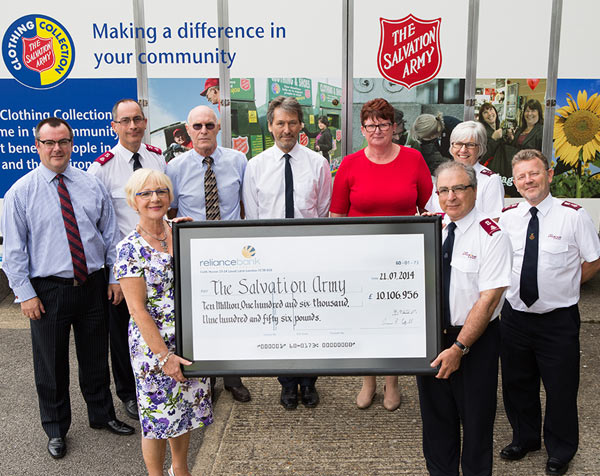
Trading arm delivers huge Gift Aid donation
The Salvation Army Trading Company (SATCoL) has been able to donate over £10.1m from its retail, reuse and recycling profits to the Salvation Army this year This huge Gift Aid donation by cheque represents a 5% increase year on year, as well as yet another record sum for the charity.
The cheque was presented by Trevor Caffull, managing director of SATCoL. Brenda Dickens, director, was there to receive the donation on behalf of The Salvation Army Trustee Company. The handover took place at SATCoL’s head office in Wellingborough, Northamptonshire.
Caffull says: “I’m incredibly proud that we have yet again set a fundraising record. It might seem like a small action to some, but just by donating clothes to our shops and recycling schemes, or buying from our retail outlets, our customers have helped to raise millions of pounds for the Salvation Army. That’s no small feat at all.”
SATCoL has experienced a strong trading year through its clothing collection operations and its charity shops, resulting in significant expansion between 2013 and 2014. The business has increased its clothing banks to over 6,500 (from 5,200 this time last year) and delivers over 400,000 clothing collection bags to homes across the UK each week. SATCoL also added a further 15 shops to its retail network taking the number of outlets to more than 190.
Court support service launches in Newcastle
The Personal Support Unit charity has teamed up with Northumbria University to operate a Newcastle-based court support service. The PSU uses trained volunteers to help people who do not have legal representation, assisting in civil and family court cases. It operates in courts across England and Wales including its new base at Newcastle Combined Court.
In this joint venture Northumbria’s Law School will provide knowledge and expertise via volunteer staff and students to help the PSU meet the anticipated demand. Student volunteers will be also joined by volunteers recruited from the local community in Newcastle to provide the service.
Kevin Kerrigan, executive dean for the Faculty of Business and Law at Northumbria University, says: “We applaud the work of the PSU which is providing a valuable service to those in need and we are proud to give our assistance. We believe hands-on experience is an essential element of students’ learning and development, and our collaboration with the PSU is a great way to achieve this while providing a valuable support network for the charity."
The work of the PSU is free and independent and in the last year it has helped more than 21,000 people across England and Wales. Newcastle PSU was formally launched by Lord Justice Briggs at an event at Newcastle Combined Court.
He said: “As the charity’s Liaison Judge I know first-hand how vital the work of the volunteers is to people in need. The civil justice system is a challenging experience for those who cannot afford legal advice and representation. It is an extremely complex and unfamiliar environment and the support which the PSU provides people without lawyers vital help in very difficult circumstances."
It is hoped that in due course the service will eventually be extended to other courts and tribunals in the area.
Comic support raises big sum
Comedian Sarah Millican has helped raise a £111,648 for Macmillan Cancer Support from her "Home Bird" tour. The stand-up encouraged her fans to donate to Macmillan at the 142 gigs that took place across the UK between September 2013 and May 2014. She asked audiences to drop their spare change into collection buckets at the end of performances.
Millican says: "Thank you to all of my lovely audiences who donated to Macmillan Cancer Support. It is a very worthwhile charity that is close to my heart and everyone who donated at my tour has helped Macmillan to continue to support people around the UK with cancer and their loved ones. What a bunch of smashers you are!
Charity housing bond raises a quick £11m
The first charity bond to be listed on the London Stock Exchange’s Order Book for Retail Bonds, which will fund accommodation for people with a learning disability, closed its offer period two and half weeks early with an oversubscription. The bond raised £11m in less than two weeks.
The bond was launched on via Retail Charity Bonds, a non-profit special purpose vehicle which is an initiative of Allia, a community benefit society with exempt charity status, and established in association with financial services firm Canaccord Genuity.
The funds raised by the bond will Mencap's housing arm, Golden Lane Housing, to invest in buying and adapting housing for people with a learning disability in their local communities. Alastair Graham, director of Golden Lane Housing, says: "The houses and bungalows for about a hundred people will also be there for future generations of people with a learning disability – the bond will provide a positive and lasting legacy.”
The 2014 Retail Charity Bond follows on from GLH’s previous £10 million corporate bond issue which closed in July 2013, which has now been invested in buying and adapting 27 high quality houses and bungalows in community settings across the country which have become home to 99 tenants with a learning disability.
